








HomeCompanyProductsServicesDownloadContactCareer

TPT - model-based testing of embedded control systems

TPT is a model-based testing tool for testing embedded systems, especially the testing of control systems. TPT supports all important fields of the test process which are in detail the management of tests, test modelling, test execution, test assessment, and test documentation.

TPT key benefits

  • Cost-efficient consistent testing for all phases of the development: One test description for all development phases (MiL, SiL, HiL). Early malfunction detection.
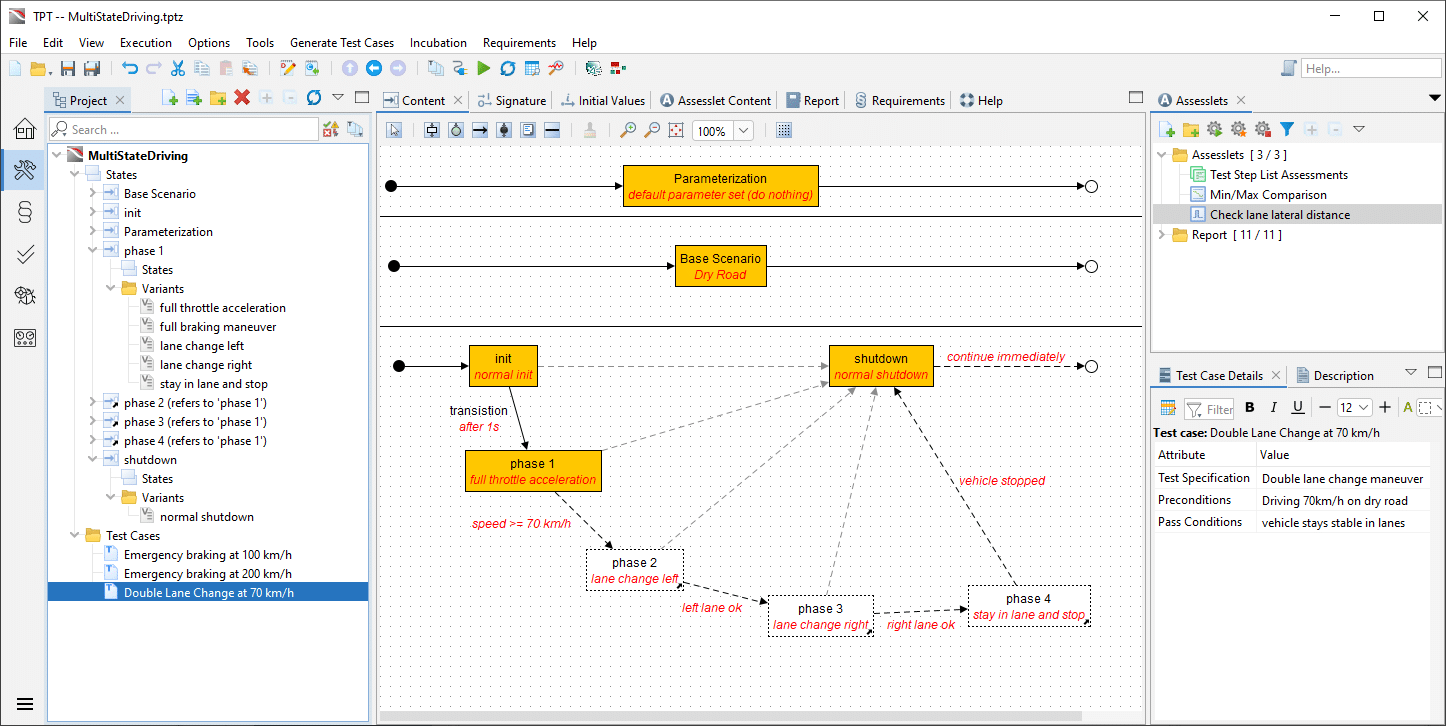
  • Intuitive test description: Model-based test development without extensive programming skills required. The graphical test-modeling is platform-independent.
  • Executable on many different Platforms: Simple integration and test execution on all platforms (e.g. MATLAB/Simulink, TargetLink, LabVIEW, ASCET, C-Code, DaVinci, SystemDesk, CAN, LIN, HiL-Tests).
  • AUTOSAR components can be tested using TPT and the execution platform DaVinci, SystemDesk or Messina.
  • Real-time enabled: On real-time-platforms the tests can be executed in real-time. The testing of controller systems is possible.
  • Closed-loop testing: TPT supports reactive tests, that is to say tests, which can react on the system’s behaviour during the test execution. Particularly when testing control systems, this possibility is essential because system mostly show a reactive nature in these fields.
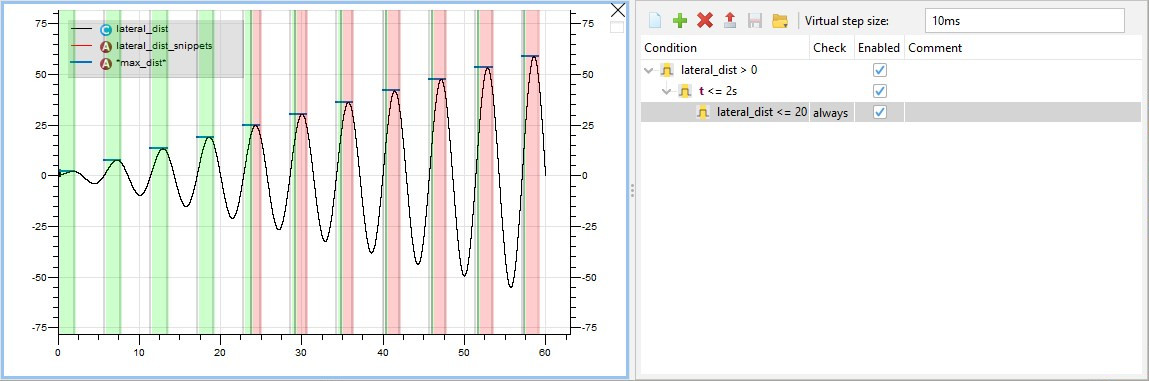
  • Efficient automatic test result evaluation: After the test run the collected data can be assessed via GUI or assessment script. This means the expected behaviour of the system is analysed systematically. The source of the analysed data can be also a different measure tool like TargetLink, Simulink signal logging data, INCA or CANape.
  • Efficient automatic test documentation: The test results are documented as information rich freely configurable HTML reports.
  • Universl test tool: The test specification (modeling) is identical for all tests (model-testing, unit-testing, Integration-testing, validation-testing, regression-testing).
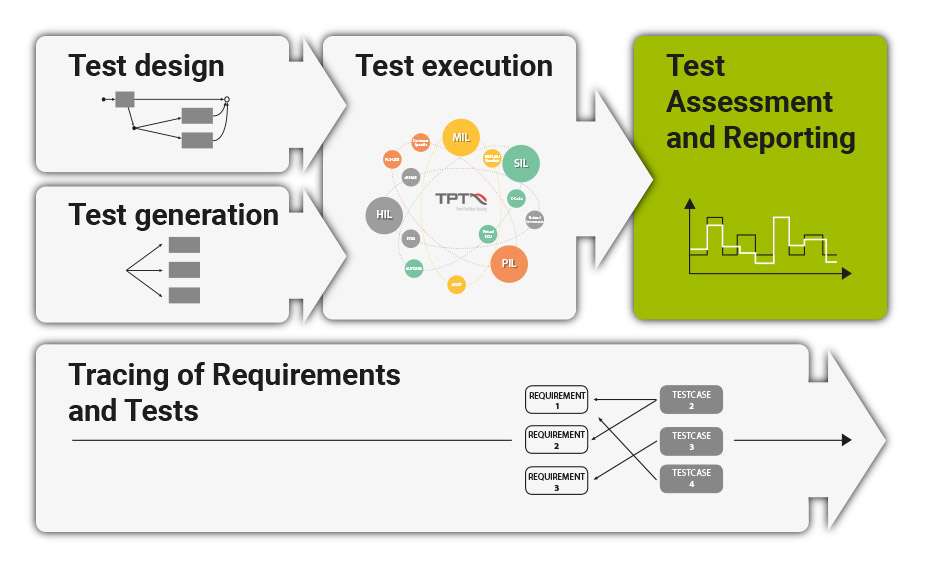
  • Automatic test process: The automatic process using TPT includes test execution, test assessment and test documentation. This process is the same using the same tool for all platforms.
  • Highest test-quality by means of systematic testing.
  • ASAM MCD-3 Measurement: Parallel to the test execution controller internal signals can be measured via MCD-3 .
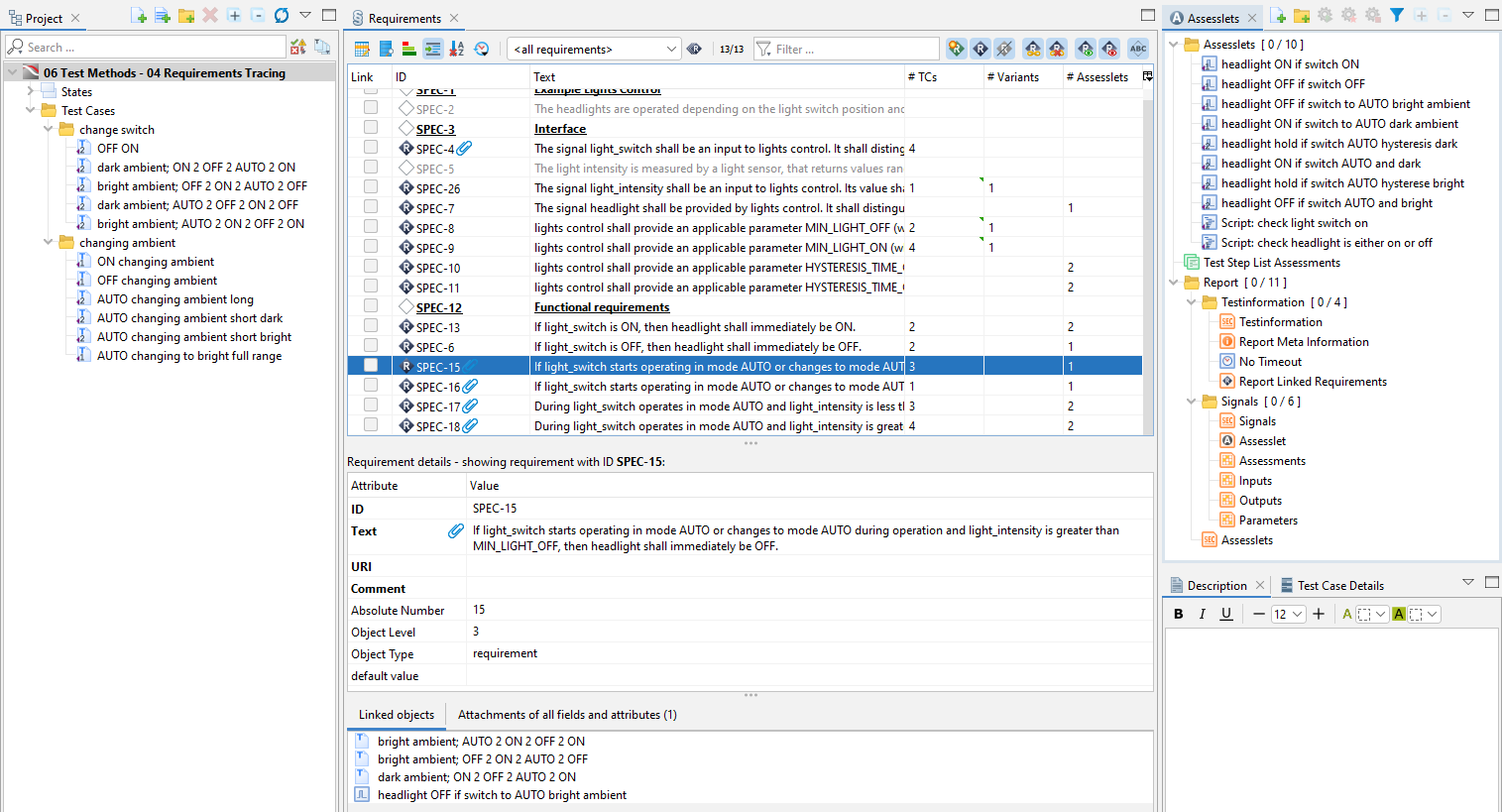
  • Requirements tracing: Traceability of requirements and tests.

Support of Tests with Continuous Signals: In the field of control engineering the in- and output variables often are continuous signals. On the market, TPT is the only systematic test tool for reactive tests of embedded systems supporting the easy modelling of test cases with continuous signals.

Automated Tests: Most of the steps of the testing process are being automated by TPT. This considerably shortens the expenditure of time for the test execution, test assessment, test documentation, and the test management. Especially at the development processes for embedded systems which often proceed strongly iterative, the automation allows efficient test repetitions and so an optimal integration of test activities into the development cycles.


Consistency: TPT allows the repetition of tests in different »in- the-Loop«-environments without modifying the test cases for the exchange between Model-in-the-Loop (MiL), Software-in-the-Loop (SiL) and Hardware-in- the-Loop (HiL). This is possible because TPT uses both a platform independent test description language and a platform independent test machine which can be integrated in almost any test environments.

Many Platforms: Simple integration in all test-platforms (e.g. MATLAB/Simulink, TargetLink LabVIEW, C-Code)

Systematic Testing: A systematic and structured choice and modelling of the test cases is of particular importance, because testing always is an empiric operation that can not prove the system quality entirely. In TPT test cases are not being looked at isolated of each other. Instead, all test cases are being created in a common model with the objective of working out common and different characteristics in order to get an overview about which aspects have been tested and which might have been neglected.

Impressum

Sitemap